Archive for March, 2010
Torquay Boys’ Grammar School vs Wellington College
 March 29th, 2010 |
  Author:
 Trefor Thynne’s team from Torquay Boys’ Grammar School have been the only serious contenders from the South West at national level since Michael Adams left Truro School, often reaching the later stages of the schools knockout championship. This year they won their zone by beating Millfield School but were then unlucky enough to be drawn away to the holders, the phenomenally strong Wellington College, near Reading.
The match was played on Monday and the Devon team duly lost 1½-4½, not unexpected, perhaps, but a little closer than the score suggests as Robert Thompson had a potentially won game at one stage. The details were as follows:
1.Felix Ynjosa (217) 1–0 Robert Thompson (170). 2.Alex Galliano (203) ½-½ Harry Mann (163). 3.Akash Jain (187) 1–0 George Darling (154). 4.Lateefah Messam-Sparks (180) 1–0 Alex Billings (122). 5.Adrian Archer-Lock (162) 1–0 Freddie Sugden (114). 6.Matthew Kim (131) 0–1 Jeff Leung (126).
This was Torquay’s only win.
White: J. Leung. Black: M. Kim.
Caro-Kann Defence [B10].
1.e4 c6 2.Nf3 d5 3.exd5 Qxd5 4.Nc3 Qa5 5.d3 Bg4 6.Be2 Nf6 7.0–0 e6 8.h3 Bh5 9.Re1 Nbd7 10.Nd2 Bxe2 11.Qxe2 Be7 12.Nc4 Qc7 13.Bg5 h6 14.Bh4 Bd6 15.Nxd6+ Qxd6 16.Bg3 White is able to keep the pressure on. 16…Qb4 17.Rab1 h5 18.Ne4 Nxe4 19.Qxe4 Qe7 20.Qd4 c5 21.Qxg7 0–0–0 22.Qc3 Nb6 23.Qe5 Kd7 24.d4 (Also good was 24.Qe4 Nd5 25.Qa4+ Kc8 26.Qxa7 h4 27.Bh2 and Black’s position has been broken open). 24…Nd5 25.dxc5 Qxc5 26.Rbd1 h4 27.Bh2 Ke7 28.Qg5+ Ke8 29.b3 b5 30.a4 b4 31.Be5 Rf8 32.Qxh4 Rg8 33.Rd2 Qc6 34.Bg3 Rd7 35.Re4 Qc3 36.Rc4! Qf6 (if 36…Qxd2 37.Rc8+ Rd8 38.Rxd8 mate.) 37.Qxf6 Nxf6 38.Rc8+ White’s pieces are better placed to exploit their long open lines. 38…Ke7 39.Rxd7+ Kxd7 40.Rc7+ Ke8 41.Rxa7 White could now simply swap pieces off and let the pawns do the rest, which Black is trying to avoid. 41…Rg6 42.Bh4 Nd5 43.a5 f5 44.Rb7 Nf4 45.g3 Nxh3+ 46.Kg2 Nf4+ 47.Kf3 Nd5 48.a6 e5 49.a7 Ra6 50.Rb8+ Kd7 51.a8=Q 1–0.
The WECU Congress starts on Friday at Exmouth and there are still spaces available for late entries. Details from A. Footner on 01935-873610 or [email protected].
WELCOME to KEVEREL CHESS
Welcome to the Keverel Chess website, which will be covering all chess matters relating to Exmouth and Exmouth players, whether played or written in the town or further afield.
In addition, there will be a selection of chess books available to discriminating collectors. Lists will be updated regularly and enquiries about books listed may be e-mailed.
Exmouth Current Season
Exmouth Current Season:
Club Championship Chart:
| ‘10 | - | ‘11 | |||||||||||
| Name | 1 | 2 | 3 | 4 | 5 | 6 | 7 | 8 | 9 | 10 | 11 | ||
| 1 | J. Stephens | 181 | X | W ½
B ½ |
W 1
B |
W
B |
W
B |
W 1
B |
W
B 1 |
W 1
B 1 |
W 0
B 1 |
W 1
B 1 |
W
B |
| 2 | M. Abbott | 177 | W ½
B ½ |
X | W 1
B |
W
B |
W
B |
W 1
B 1 |
W
B |
W ½
B |
W
B 1 |
W 1
B |
W
B |
| 3 | P. Kennedy | 151 | W
B 0 |
W
B 0 |
X | W
B |
W
B |
W 1
B ½ |
W
B |
W 0
B |
W 0
B |
W 0
B |
W
B |
| 4 | D. Rogers | 150 | W
B |
W
B |
W
B |
X | W
B |
W
B |
W
B |
W
B |
W
B |
W
B ½ |
W
B |
| 5 | S. Murray | 143 | W
B |
W
B |
W
B |
W
B |
X | W
B |
W 1
B 1 |
W
B |
W
B |
W 1
B |
W 1
B |
| 6 | R. H. Jones | 138 | W
B 0 |
W 0
B 0 |
W ½
B 0 |
W
B |
W
B |
X | W ½
B 1 |
W 0
B |
W
B ½ |
W 1
B 1 |
W
B |
| 7 | T Badlan | 122 | W 0
B |
W
B |
W
B |
W
B |
W 0
B 0 |
W 0
B ½ |
X | W 0
B 0 |
W 0
B |
W
B 0 |
W ½
B ½ |
| 8 | J. Dzenis | 120 | W 0
B 0 |
W
B ½ |
W
B 1 |
W
B |
W
B |
W
B 1 |
W 1
B 1 |
X | W
B 0 |
W
B |
W
B |
| 9 | O. Wensley | 120 | W 0
B 1 |
W 0
B |
W
B 1 |
W
B |
W
B |
W ½
B |
W
B 1 |
W 1
B |
X | W ½
B 1 |
W 1
B |
| 10 | M. Belt | 118 | W 0
B 0 |
W
B 0 |
W
B 1 |
W ½
B |
W
B 0 |
W 0
B 0 |
W 1
B |
W
B |
W 0
B ½ |
X | W ½
B |
| 11 | F. Hodge | 111 | W
B |
W
B |
W
B |
W
B |
W
B 0 |
W
B |
W ½
B ½ |
W
B |
W
B 0 |
W
B ½ |
X |
| Updated: | Feb |
Rate of moves: 36 moves in 75 minutes + 15 minutes thereafter for the rest of the game.
Each player is responsible for ensuring that his results are entered on the club chart at the earliest opportunity after the game is played.
A Brief History
Exmouth Chess Club
A Brief History of Chess In Exmouth.
by R. H. Jones.
(Updated 01.12.09)
The first mention of a chess club in Exmouth can be found in the 1st edition of the Year-Book of Chess 1907, where it appears below the four clubs in Exeter. However, no details are given, and it doesn’t appear again in subsequent lists, so its very existence at this time must be in some doubt.
It would, however, be strange if Exmouth, one of Devon’s larger towns, did not have a club at a time when even small villages supported one. After all, if places like Winkleigh could support a club, why not Exmouth. It may have been that its proximity to Exeter, whose club at the Barnfield building was open 12 hours a day, every day, was a demotivating factor.
At the 1947 AGM the Secretary made the following interesting observation in his report: “I am sorry to record that we are loosing (sic) one of our oldest members in Mrs. Carter, who joined the club during the 1st World War”…. This is the earliest direct reference I can find to a club existing in Exmouth in the early years of the 20th century.
In 1922 an Exmouth Club affiliated with the Devon County Chess Association, its premises being the Y.M.C.A. in Victoria Road, meetings on Wednesdays between 6 and 10 p.m. The secretary was W. Thompson Godfrey of 4, Johnson’s Place, Exmouth. They entered the Moyle Cup, the lower of Devon’s two divisions, then run on a knock-out basis and won it at their first attempt. The only record is Exmouth’s name on the trophy.
The D.C.C.A.’s annual report in 1924 noted that the club had moved to the Book Club in Rolle Street. Mr. Godfrey’s address was given as the Midland Bank Chambers, Exmouth. It had 10 members, namely Messrs F. Crane, H. C. Huggins, A. E. Jupe, E. Llewellyn, H. Price, H. St. A. Sims, H. Taylor, F & M. Tucker.
Their membership of 10 was small compared with those of other clubs that year: e.g. Bideford (13); Dawlish (12); Paignton (14); Tavistock (18) and Totnes (17).
In the 1923-24 season Exmouth defended the Moyle Cup, but lost to Teignmouth & Shaldon 4½ - 1½, its significance being that it was Exmouth’s first recorded match result. The following season Exmouth entered again, this time losing to Newton Abbot 5 – 1 in a preliminary round. It was no great disgrace as Newton Abbot went on to beat Teignmouth & Shaldon in the Final, also by 5 – 1.
Exmouth then disappears off the chess radar until February 1929 when the present club was formed. J. Mackenzie took the initiative in convening an initial meeting on 11th February at which it was decided to call the club “The Exmouth Chess Club” and the rental of £9 for the rest of the year at the Church Institute was agreed. The moment must have been propitious as 20 members paid up their 52p annual subscription in just a few weeks. These included several of the earlier club, Messrs Godfrey, Llewellyn, Taylor and the Tuckers.
The 1st AGM was held in October 1929 at which the Secretary, M. Tucker, read out his report, as follows:
Mr. Chairman, Ladies & Gentlemen,
The Exmouth Chess Club, after a lapse of some years, was re-formed early in the year through the initiative of Mr. J. Mackenzie to whom the thanks of the members are due and have been accorded.
A few people who promised to join backed out, but we have a total membership of 20, which though quite a good start is not quite enough to place us in a sound financial position, and all members are asked to give the names of any chess players to the Secretary that he may write to them to join the Club.
The attendance on the Tuesday afternoon meeting was quite satisfactory and thanks are due to those ladies who arranged for the teas which is much appreciated.
On Friday evenings the attendance was chiefly remarkable by its absence.
From this one can infer that it was a club for the retired or well-to-do rather than working-class folk.
They affiliated to the Devon County Chess Association, and entered the Moyle Cup for the 1929–30 season. They reached the final eventually losing to Plymouth, and exactly the same thing happened the following season.
In 1934, the DCCA President, Robert Newman, Lord Mamhead, donated a new cup for Devon clubs for middle-ranking teams, in between the Bremridge and Moyle Cup competitions. Exmouth entered and were the first winners, repeating the feat in 1936 and again in 1938.
Throughout the autumn of 1935, Sir George Thomas, British Champion the previous year, was raising funds to help finance the great International Tournament in Nottingham in 1936. To this end he toured Devon giving three simultaneous displays. On 3rd December he visited Exeter and played 21 local people in the Barnfield Hall. Of these, 8 came from the Exmouth Club, namely Revd. Glynn Grylls, Revd. C. W. Light, F. H. Light (Club Match Captain), Capt. Mackenzie (Club Vice President), A. D. Murray, L. S. Shadbolt (Club President), M. Tucker and A. C. White. All lost.
By the 1937 AGM the club had moved in successive seasons from the Church Institute to the Blue Café to the Byron Hotel to Moreton Crescent. Confidence was slowly growing as there was a proposal that the Club should again enter Devon’s Division 2, the Mamhead Cup, with an amendment that they should enter Devon’s top league, the Bremridge Cup. However, more cautious spirits among the membership prevailed and both proposal and amendment were defeated. So for some unexplained reason the club voted not to enter the Mamhead Cup in 1937, of which they were the only holders and would win again the following year. Similar caution determined that they should not invite Znosko-Borovsky to give a simultaneous match in the club after his visit to Exeter.
Koltanowski in 1925, aged 22
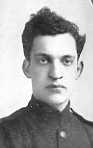
The Belgian Champion, George Koltanowski, (1903 – 2000) had met and befriended A. R. B. Thomas, teacher at Blundell’s School, Tiverton, when they both played in the 1st Margate Congress in 1935. Koltanowski came to stay with Thomas several times including a week in November 1937. Earlier that year Koltanowski had set a new world record of playing 34 opponents simultaneously blindfold, winning 24 and drawing 10. The Secretary had written to Koltanowski about visiting the Exmouth Club but had not received a reply. They persisted with the invitation and eventually he did come to Exmouth on November 22nd 1937, as part of a tour of the Westcountry, that included Teignmouth, Plymouth, Liskeard and Bristol.
The match was held at the YMCA in Victoria Road. In the afternoon the Belgian played two games simultaneously, one against Harold Mallison, lecturer in Maths at Exeter University College, Devon’s strongest player at the time and another against a team of club members who were allowed to discuss their moves. In the evening he played a full simultaneous match against all club members, winning 14 and drawing 2, with no losses. In spite of Mallison’s meticulous recording of his games, no trace of this particular game can be found among his many scorebooks.
With the outbreak of war, there was clearly much debate at all levels about how the chess world should respond to the unusual circumstances. Was it proper, for example, to be playing at warfare, while others are engaged in the real thing. Also, there was the question of the personal safety of players crossing the county to play matches at a time when Exeter and Plymouth city centres were being bombed flat. At their 1940 A.G.M. the following resolution was passed: “That the Secretary write to (Devon Secretary), Mr. Pitt-Fox, to say ‘That the Exmouth Chess Club, while willing to fall in with any decision of the D.C.C.A. am of the opinion that the time is not suitable for chess on the county scale’”. In accordance with wishes, DCCA suspended inter-club competitions for the duration of the war, although the club continued throughout the war years. No club members were reported killed during Exmouth’s own bombing raids.
Normal services were resumed after the war and members voted to enter the Mamhead Cup again for the1945 – 46 season. The new premises were at the Seagull Hotel.
Ever since 1929 the minutes tell a story of continued concern about the need to get more members, whether through personal contact or adverts in the local press. There had consistently been over 20 members, but this was not deemed sufficient for the club’s financial well-being. The names of members listed in 1945 tells its own story. They were: Mrs. Adams; Miss Carlyon; Miss Beard; Miss Barclay; Miss Follett; Miss Harding; Mrs. Horne; the Rev. Addinbrook; the Rev. Bull; P. Wood; Lt. Col. Beadon (President); Col. Campbell; A. A. Branson; J. H. B. Foss; James Guild (Secretary); F. J. Eckroyd; Denis P. Bonner; H. Taylor (Auditor); George Cottew; Dr. McDonagh; Dr. Geidt; F. H. Light. Mr. O’Farrell.
It sounds like a collection of mainly the military, clergy and elderly spinsters, though this is probably not doing them justice. The general level of play among them is illustrated by two comments in the minute book at this time.
Firstly, at the 1947 A.G.M. the Secretary noted that Mr. J. H. B. Foss had played for Devon against Gloucestershire, one member playing in one match for Devon being a fact worthy of recording for posterity. Secondly, a little later we read the following “The President then referred to a very important rule in the game of chess which he noticed was being frequently ignored, that is that is a piece is touched by a player, then that piece must be played”. The underlining was by the secretary.
Having said that, there was one bright star among this constellation – that of Denys Bonner. He had moved to Exmouth aged 13 when his parents took over the Moriglen Private Hotel on the Salterton Road. On leaving school he joined the Westminster Bank in Exmouth. Eventually, he became Manager of the Westminster Bank in Glastonbury, Somerset, and he won the Somerset Individual Championship so many times they gave him the trophy to keep, and he donated a replacement. (see Bonner’s biography on this site for more details of his chess life).
1950 marked the start of a minor golden period for Exmouth. Firstly, they won the Mamhead Cup that year and in 1951, 1952 and 1954.
Mamhead Cup DCCA Div 2 1950
| P | W | D | L | Pts | ||
| 1 | Exmouth | 5 | 4 | 1 | 0 | 9 |
| 2 | Plymouth | 5 | 4 | 0 | 1 | 8 |
| 3 | Exeter | 5 | 3 | 1 | 1 | 7 |
| 4 | Torquay | 5 | 2 | 0 | 3 | 4 |
| 5 | Tavistock | 5 | 1 | 0 | 4 | 2 |
| 6 | Teignmouth | 5 | 0 | 0 | 5 | 0 |
The team members were J. H. B. Foss; Rev. Addinbrook; D. P. Bonner; A. A. Branson & Col. Campbell. The Club paid half of the players’ travelling expenses to away matches.
At their AGM on 26th September 1953, a new venture, the creation of an Exeter & District Chess League was flagged up, and Denys Bonner was deputed to attend an exploratory meeting at the Exeter Club three days hence, to assess the interest.
At this meeting, Bonner was joined by Ted Hesse (Civil Service), Denys Gray, (a pupil at Exeter School and later to become Sir Denys) and G. R. Cottew, T. J. Maddick and S. P. Gibbons of the home club. It was clear that the will was there, so the plan was put into action and a set of rules agreed. Cottew, formerly a member of the Exmouth Club before transferring to Exeter, and clearly the driving force behind this move, was elected League President and donated a cup, the Cottew Cup.
Two weeks later, Bonner reported to a Committee Meeting of the Exmouth Club. The rules were read out and discussed, and the five members present voted unanimously to join in.
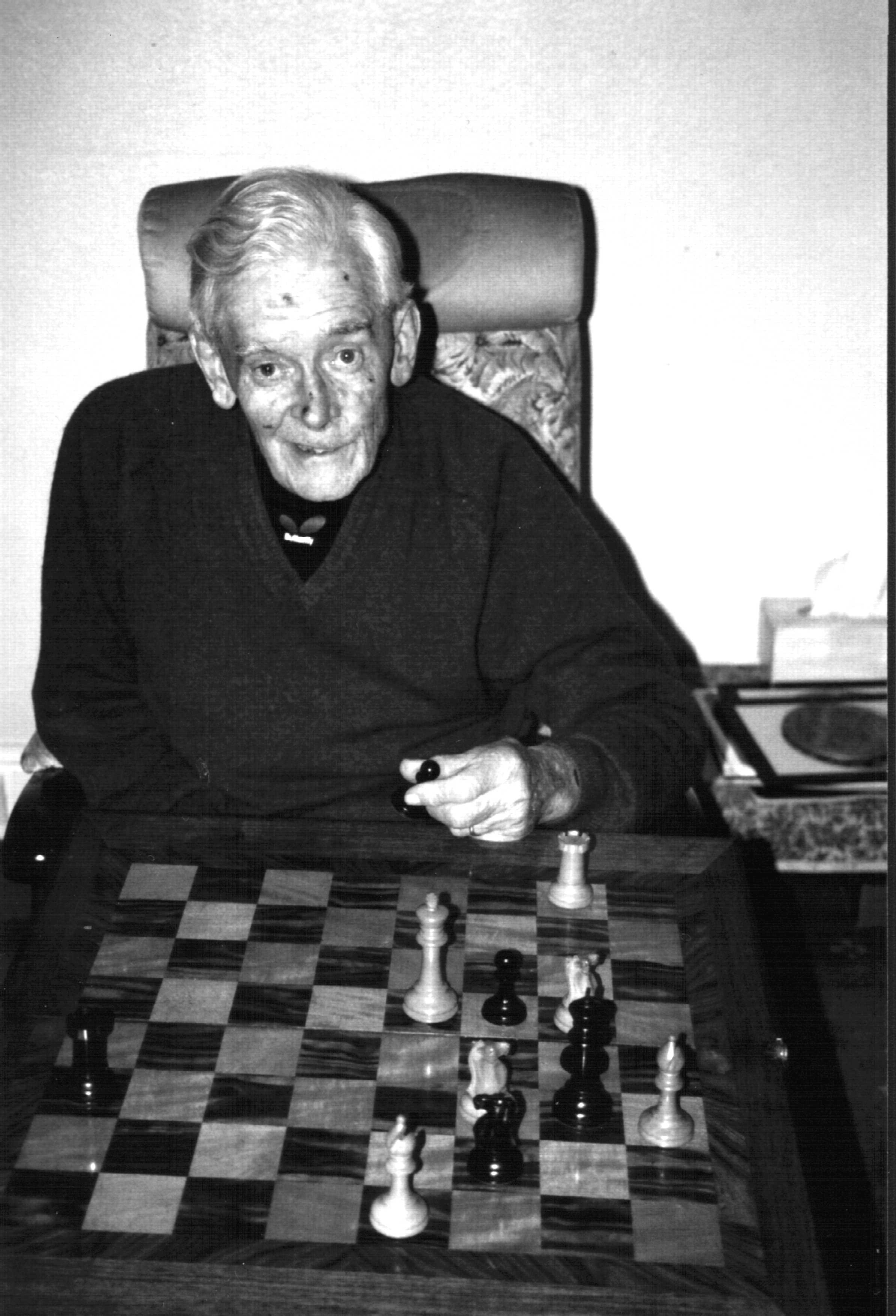
Above: Bonner in 2003, aged 85, working on one of his problem compositions at home in Exeter.
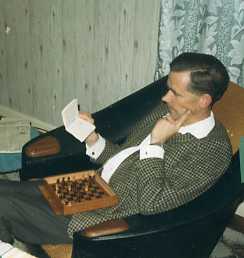
Below: Bonner in his prime working on his postal game.
A new member, a strong player called G. T. Womack, was elected as Match Captain for the League Team, as Denys Bonner was due to move to Somerset before the end of the year. It was clear that the League, as originally conceived was intended for players who were of about Devon’s 2nd or 3rd Divisions. For example, in the first season, Exeter’s team was listed as Exeter Moyle, and later as Exeter “C”, that is, equivalent to Devon’s 3rd division.
In the event, the League’s first season comprised six clubs, namely Exeter, St. Luke’s Teacher Training College, St. Loyes College, Exeter School, Exeter University College and the Civil Service. Exmouth had no trouble in winning the League in its first season and becoming inaugural winners of the Cottew Cup. Unfortunately, Bonner moved to the Yeovil branch of his bank and Womack died suddenly at the end of the season. This knocked the stuffing out of Exmouth’s 1st team, and they won no more major cups for almost 20 years.
In 1955, the club moved from the Seagull Hotel to the rather grander Imperial Hotel, where they stayed until it burned down.
In 1959, Lt. Col. Beadon, who had been President for 22 years, died. 1960 saw the arrival of V. G. Tempest, a strong player from Sidmouth, who within a few years had done every job in the club. In the summer of 1969, however, he died following a stroke, and Guy Sparke raised a subscription to pay for a new trophy in his memory. This became the Club Championship trophy. In the 1964-65 season no matches were played at all “owing to lack of membership”. The Club’s profile was again at a low ebb.
By the late 60’s however, some fresh blood arrived. Local lad Fred Hodge joined, and Guy Sparke and his son Philip returned from farming in Kenya. R. H. Jones from Budleigh was also a talent, (not to be confused with the other R. H. Jones who moved to Exmouth from Teignmouth in 1971 - that often led to confusion). 1970 saw the arrival of several players who were to prove significant in the club’s fortunes. Retired civil servant with Thames Water, Ken Schofield, graded c. 180; a local teenager Stuart Landon, who was to achieve 150+ grading, and a young student at nearby Rolle College, Steve Boniface (c.150).
The new players were instrumental in creating a more informal ambience within the club. From the Club’s start members had always addressed each other by their surnames or other honorifics. So a typical conversation might go thus: “Good evening, Mr. Hodge”. “ ‘ Evening, Major. I’d give you a game but I‘m due to play the Colonel tonight”. Then, a small Management Committee meeting in 1971 changed all that when new member Ken Schofield went a step too far, dropped the “Mr” and addressed his colleague simply as “Hodge”. Fred bridled at this and retorted “Hang on a minute – call me Fred, Mr. Hodge or Sir, or don’t talk to me at all”. Guy Sparke calmed the situation by suggesting that, in future, members call each other by their first name, which is how it’s been ever since.
This new generation was much keener to play in tournaments outside the club, and it certainly showed in results. In 1971 Exmouth entered two teams in the Exeter & District League for the first time. Ken Schofield entered the Devon Individual Championship, losing only to Peter Clarke, while Fred Hodge won not only the DCCA Minor Championship but also the Exeter & Dist. Individual Champion jointly with David Tout.
The only downside during that season was the death of a member, Norman Calvert, in the middle of Exmouth’s home match against Exeter University A. Earlier in the evening Calvert had approached the team Captain, Fred Hodge, saying he was feeling unwell and asked whether someone could take his place, but no one was available. As the match progressed, Exmouth had got the upper hand in most games and seemed on the verge of victory over their much stronger opponents, but suddenly Calvert slumped over the board scattering pieces everywhere. Fred Hodge gave mouth-to-mouth resuscitation, but in vain. The hotel Manageress was very helpful in calling the emergency services. The match was re-scheduled, but Exmouth lost.
The upward trend was continued during the 1971-72 season, when for the first time in almost 20 years Exmouth entered the Mamhead Cup, and rediscovered their happy knack of winning it, beating the North Devon champions, Barnstaple, in the Final by 3½-2½. (see chart below).
A celebratory photograph was taken in the clubhouse of the Budleigh Salterton Croquet & Lawn Tennis Club. (see below).
| Mamhead Cup | Grd | Date: 24.06.72 | |||
| Play-off | |||||
| Exmouth I | Barnstaple II | ||||
| 1 | K. S. Schofield | 171 | ½ | ½ | W. J. Welch |
| 2 | E. G. Sparke | 146 | 1 | 0 | P. A. Jones |
| 3 | S. R. Boniface | 161 | 1 | 0 | J. Parker |
| 4 | R. H. Jones | 135 | 0 | 1 | E. H. Jones |
| 5 | S. Landon | 120 | ½ | ½ | R. H. Stacey |
| 6 | F. R. Hodge | 116 | ½ | ½ | F. V. Pye |
| 3½ | 2½ |
In addition, Guy Sparke played in all six of Devon’s county matches, winning every game. In fact, a car full of Exmouth players played in all county matches at this time. Ken Schofield won through to the final of the Devon individual championship, losing to A. R. B. Thomas.
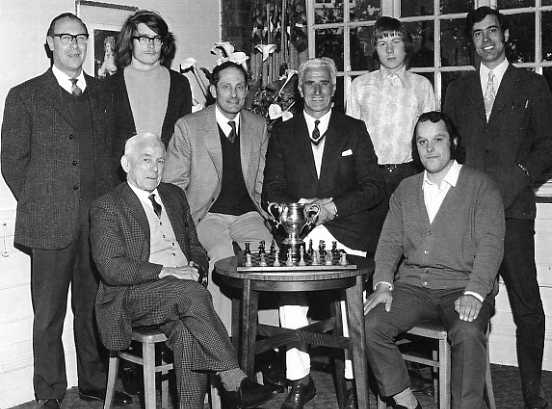
Exmouth’s pool of players in the Mamhead Cup 1971 – 72
Taken at the Budleigh Salterton Lawn Tennis & Croquet Club.
Seated (l – r): Tom Grozier; Fred Hodge. Back row: Bernard Landon; Steve Boniface; Guy Sparke; Ken Schofield; Stuart Landon; Bob Jones.
Disaster struck later in November 1972 when their venue of 17 years, the Imperial Hotel, was gutted by a fire that killed 5 people and the Manageress’s cat, one of the five being the Manageress herself who had re-entered the burning building to rescue her cat. At the next Management Committee meeting, the Secretary, Bernard Landon, recorded that “Mr. Sparke was instructed to make an immediate claim against the Club’s insurers for the full sum as it was felt that, in view of the extensive damage to the Hotel, it was extremely unlikely that anything would be salvaged”. At the next meeting it was reported that the insurers had settled the claim in full to the tune of £10.50. However, a basic rule of physics had been overlooked – i.e. that heat rises, and that as the clubroom had been situated in the Hotel’s games room below ground level, the club’s equipment was recovered more or less intact.
The more pressing problem was that of finding a new venue. Steve Boniface was very helpful in getting a move to Rolle College, where he was a student and where the Club remained for the next 36 years.
The Fischer-Spassky match of 1972 raised the game’s profile to unprecedented levels and Exmouth rode the wave, with a number of developments, making the 1970s a new Golden Age for Exmouth Chess. On the strength of the public interest, especially among juniors, Bob Jones started the Exmouth & District Primary Schools Chess League, which he ran until his retirement 25 years later. In May 1975, Bernard Landon and Steve Boniface joined with Jones to hold a one day congress open to the pupils of the 16 primary schools in Exmouth and district. This was first held in Rolle College on Saturday 24th May 1975. It was successful and continued for the next 22 years. It was the first congress that Boniface had organised, and from here he went on to become one of Britain’s top arbiters, eventually receiving his badge as FIDE Arbiter at an event in Exmouth, just yards from where he started his arbiting career.
About this time, Steve Boniface and Bernard Landon started a Junior club that met in the College on a Saturday morning, and a junior club continued to meet at Rolle College for the next 25 years, run by first Fred Hodge and then Tim Onions.
The structure of junior chess within Exmouth at this time was successful in enabling a number of young players to reach their potential. Firstly, most primary schools in the greater Exmouth area were involved in the Primary School League, and had the facilities to allow any of their pupils to play informally. The better ones then played for their school team in the League, and the keener ones could join the junior club at Rolle College. Players who came up through this system included, for example, Robin Cotton of Otterton Primary School, who became Devon U-11 Champion and later became one of Exmouth’s strongest players. He played in the 1980 British U-16 Championship in a section won by Peter Wells, future GM. Chris Scott had a similar career, coming 5th in the British U-14 Championship in 1975, in the process rubbing shoulders with the likes of Julian Hodgson, Malcolm Pein and Nigel Short in adjacent sections. Later, John Stephens progressed through this structure to become Exmouth’s senior champion. Whatever the talent or ambition of any junior player in the greater Exmouth area, the structure existed to enable it to be fulfilled.
Throughout 1974, Ken Schofield was finalising plans for a new congress based in Exeter. This was to become the East Devon Congress, which he hoped would be an integral part of the local league rather than separate from it. To help unify the two entities, he lobbied the League A.G.M. that they should change the name of the league to the East Devon League, an idea that was turned down both then and on several future occasions. Plans were slow to develop but eventually came to fruition in 1976.
On the strength of their victory in the Mamhead Cup in 1972, the Club elected to enter Division 1, the Bremridge Cup for 1972 – 73. Optimism was high after beating Teignmouth in their first-ever Bremridge match, but they were never a match for the top clubs of the day, Exeter, Plymouth and the University, as the records below clearly show.
| Bremridge | Grd | Date: 4.11.72 | Date: 12.12.72 | Grd | ||||||||
| Exmouth I | Teignmouth I | Exmouth I | Exeter I | |||||||||
| 1 | K. S. Schofield | 171 | 1 | 0 | T. F. Thynne | 169 | K. S. Schofield | 0 | 1 | A. R. B. Thomas | 203 | |
| 2 | S. R. Boniface | 161 | 1 | 0 | R. S. Thynne | 162 | S. R. Boniface | 0 | 1 | R. A. Lee | 188 | |
| 3 | E. G. Sparke | 146 | ½ | ½ | P. E. Halmkin | 154 | E. G. Sparke | ½ | ½ | M. Gilhespy | 165 | |
| 4 | R. H. Jones | 135 | ½ | ½ | I. S. Annetts | 144 | G. C. Lund | ½ | ½ | B. W. Clapp | 169 | |
| 5 | G. C. Lund | 120 | ½ | ½ | R. Liggitt | 145 | R. H. Jones | 0 | 1 | M. A. Cartwright | 172 | |
| 6 | F. R. Hodge | 116 | ½ | ½ | W. A. Frost | 142 | S. Landon | 0 | 1 | M. W. Wood | 171 | |
| 849 | 4 | 2 | 916 | 1 | 5 | 1068 | ||||||
| Date:27.01.73 | Date: 24.03.73 | |||||||||||
| Exmouth I | Plymouth I | Exmouth | ½ | ½ | Exeter Uni. | |||||||
| 1 | K. S Schofield | 171 | ½ | ½ | R. M. Bruce | 177 | K. S. Schofield | 0 | 1 | D. Sewell | ||
| 2 | S. R. Boniface | 161 | 0 | 1 | G. W. Wheeler | 178 | E. G. Sparke | 0 | 1 | S. J. Mann | ||
| 3 | E. G. Sparke | 146 | 0 | 1 | R. Delnon | 189 | R. H. Jones | 1 | 0 | R. H. Lingham | ||
| 4 | G. C. Lund | 140e | 0 | 1 | P. S. Beighton | 160 | G. C. Lund | 0 | 1 | C. Hatch | ||
| 5 | R. H. Jones | 135 | 1 | 0 | J. K. Gross | 169 | J. Bennett | ½ | ½ | R. Heasman | ||
| 6 | F. R. Hodge | 116 | 0 | 1 | K. Bloodworth | 158 | N. Benson | 0 | 1 | H. Ditmas | ||
| 869 | 1½ | 4½ | 1031 | 2 | 4 |
The fact was that Exmouth was too strong for the 2nd Division and not strong enough for the 1st. So they tended to go up and down in successive seasons.
In March 1976, Ken Schofield’s plans for a new event bore fruit, when the first East Devon Congress took place at Exeter University. There was a hiccup at the first prizegiving, but this did not detract from the event’s fundamental success and it has gone from strength to strength, eventually moving to St. George’s Hall in the heart of the city.
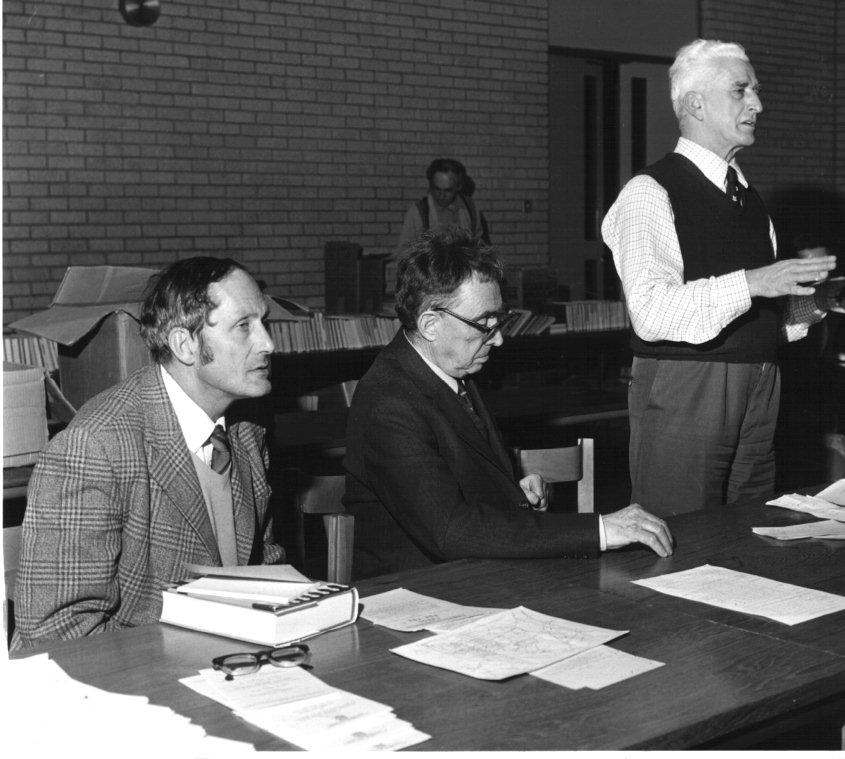
Below: Ken Schofield introducing the guest, A. R. B. Thomas, at the opening of the first East Devon Congress at Exeter University.
Congress Secretary, Guy Sparke looks on, while Peter Clarke prepares his bookstall in the background.
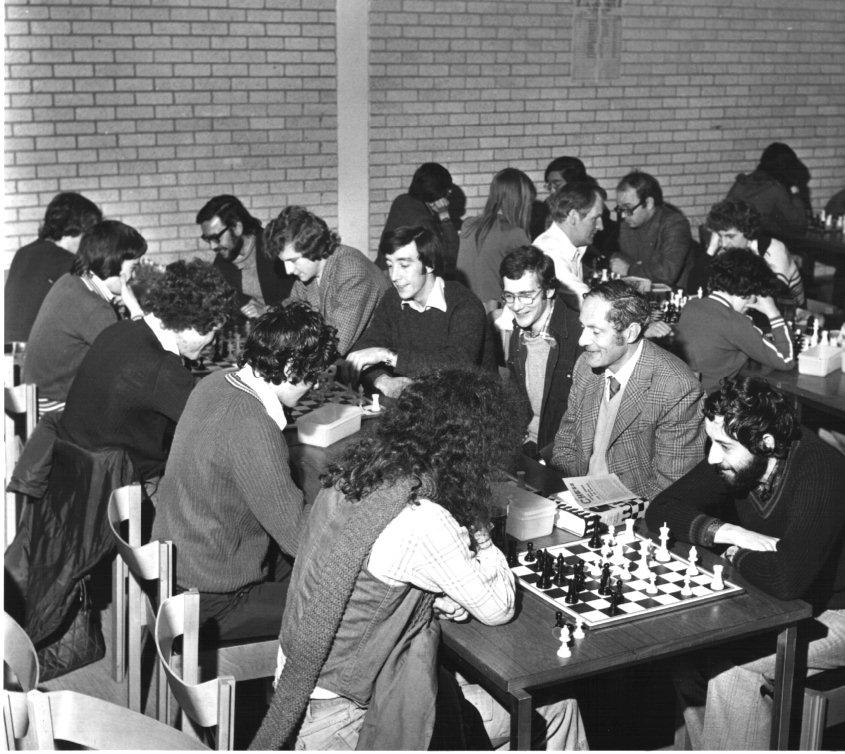
Above: A scene from the 1st East Devon Congress, specially posed for the local paper.
Nearest camera Exmouth player Malcolm Horne is playing a bearded Ralph Heasman, Guy Sparke is playing his own son, Philip, watched by Exeter player Chris Bellers who is sitting next to Jon Kelway.
The nearest thing to a department store in Exmouth was the family-owned Walton’s in Rolle Street opposite where the Sunlit Café used to be. Such was the growing interest in all things chess-related in 1975 that another interesting project took off. A pupil at Exmouth Community College had constructed a most unusual chess set out of wood as one of his school projects. The set somehow got into the local press and came to the attention of the shop’s owner, Mr. Walton-Turner, who spotted a publicity gimmick that suited both parties, the shop and the chess club.
After some discussion it was agreed that he would donate a cup for a knockout tournament that was to conform to several criteria:
(a) Games should be played in his shop window, in the evenings.
(b) The strange set had to be used.
(c) It should be open to anyone in Exmouth who wished to play, not just club members.
(d) It had to take place in early November, after he had cleared out his autumn displays and before the Christmas stuff came out.
And that is exactly what happened for several years. At about 7 p.m. two players and a third person who would be taking down the moves, would foregather near the back of the shop, (now near the kiosk in the Magnolia Centre), and wait to be let in by the caretaker. The set was already in place on a low table, so that spectators outside could watch the action, and the game went ahead. Of course, being the first week in November, fireworks were regularly let off in the vicinity, clearly with the intention of disturbing the players’ concentration, but no harm was ever done. Occasionally a small group of passers-by would congregate to see what on earth was going on.
Eventually, two finalists would emerge and the final had to be played on a Saturday afternoon when the Magnolia Centre was at its busiest. In its early years it seemed the cup was generally won by a strong newcomer. The publicity aspect of the tournament worked well, as the club got several new regular members from the small groups that looked in through the window. Eventually, Walton’s went the way of most small department stores in the new global economy, but the tournament continued in-house and is still played for every year on a knock-out basis. The early winners were:-
| Year | Winner | Year | Winner | Year | Winner | ||
| 1975 | Ivan Legg | 1990 | Bob Jones | 2005 | |||
| 1976 | Stuart Landon | 1991 | Guy Sparke | 2006 | |||
| 1977 | Stephen Crockett | 1992 | Dave Rogers | 2007 | |||
| 1978 | Stuart Landon | 1993 | Fred Hodge | 2008 | |||
| 1979 | Trefor Thynne | 1994 | Malcolm Belt | 2009 | John Stephens | ||
| 1980 | Robin Cotton | 1995 | Bob Jones | 2010 | |||
| 1981 | Guy Sparke | 1996 | Malcolm Belt | ||||
| 1982 | Guy Sparke | 1997 | Philip Trussler | ||||
| 1983 | Tim Buckley | 1998 | Philip Trussler | ||||
| 1984 | Guy Sparke | 1999 | Philip Trussler | ||||
| 1985 | Malcolm Horne | 2000 | Philip Trussler | ||||
| 1986 | Rev. Denis Tongue | 2001 | Philip Trussler | ||||
| 1987 | Nicholas Worthing | 2002 | |||||
| 1988 | Arthur Coates | 2003 | |||||
| 1989 | Nicholas Worthing | 2004 |
Throughout the 1970s Exmouth persevered with their entry to the Bremridge Cup, notwithstanding their lack of strength in depth – they were always one or two good players short to be able to compete with the likes of Exeter, Teignmouth and Plymouth, though the results of the 1976-77 season show that no team could take them lightly.
| Bremridge | Date: 4.12.76. | Date: 22.01.77. | |||||||
| Exmouth | Exeter | Exmouth | Torquay | ||||||
| 1 | I. Legg | 0 | 1 | D. Richardson | K. S. Schofield | 0 | 1 | M. Roberts | |
| 2 | S. R. Boniface | 0 | 1 | J. Ottoson | S. R. Boniface | ½ | ½ | A. M. Tyrell | |
| 3 | E. G. Sparke | 0 | 1 | D. J. Richards | E. G. Sparke | 1 | 0 | D. Smith | |
| 4 | R. H. Jones | ½ | ½ | C. J. V. Bellers | R. H. Jones | ½ | ½ | A. Kerry | |
| 5 | P. Sparke | 1 | 0 | Dr. R. Hitchcock | P. Sparke | 0 | 1 | B. Boomsma | |
| 6 | G. C. Lund | 0 | 1 | S. M. Owen | S. Landon | 1 | 0 | M. Turner | |
| 1½ | 4½ | 3 | 3 | ||||||
| Date: 05.02.77 | Date: 19.02.77 | ||||||||
| Exmouth | University | Exmouth | Teignmouth | ||||||
| 1 | S. R. Boniface | 0 | 1 | P. Broad | K. S. Schofield | ½ | ½ | T. F. Thynne | |
| 2 | K. S. Schofield | 0 | 1 | P. Pritchard | S. R. Boniface | 0 | 1 | P. E. Halmkin | |
| 3 | E. G. Sparke | 1 | 0 | R. H. Lingham | E. G. Sparke | 0 | 1 | R. S. Thynne | |
| 4 | R. H. Jones | 1 | 0 | J. Hutchings | R. H. Jones | ½ | ½ | R. Liggitt | |
| 5 | P. G. Sparke | ½ | ½ | T. Landsman | S. Landon | ½ | ½ | B. J. Penaligen | |
| 6 | C. Lund | ½ | ½ | G. Reason | I. Ashford | 0 | 1 | I. S. Annetts | |
| 3 | 3 | 1½ | 4½ | ||||||
| Date: 12.03.77 | |||||||||
| Exmouth | Plymouth | ||||||||
| 1 | K. S. Schofield | 1 | 0 | G. W. Wheeler | |||||
| 2 | E. G. Sparke | ½ | ½ | R. M. Bruce | |||||
| 3 | C. J. Scott | 1 | 0 | S. Williams | |||||
| 4 | P. Sparke | 0 | 1 | K. Bloodworth | |||||
| 5 | S. Landon | ½ | ½ | Rowena Bruce | |||||
| 6 | C. Lund | 0 | 1 | C. Gilbey | |||||
| 3 | 3 |
In 1979 the Club celebrated the 50th anniversary of its latest incarnation. A sub-committee had been formed some time before to make plans, the main ones being two commemorative matches. In one, Exmouth combined with Teignmouth who were celebrating their 75th year (incorrectly, as we now know – the club was actually founded in 1901), and an outdoor match was held on the Maer, adjacent to the promenade. June it may have been, but it was cold and windy enough to disturb the pieces.
In a second match, Ron Bruce, the Devon Match Captain, agreed to raise a team of 12 from the rest of Devon that would roughly match Exmouth’s current strength, with total grades of each team being under 1500. This took place on June 3rd in Rolle College.
The scores were as follows: (Exmouth names first)
1. K. S. (Ken) Schofield 1 - 0 G. W. (Gary) Lane (def.)
2. S. R. (Steve) Boniface 0 - 1 R. M. (Ron) Bruce
3. Stuart Landon 0 - 1 R. M. (Rowena) Bruce
4. Stephen Crockett 0 - 1 J ohn Walker
5. E. G. (Guy) Sparke 1 - 0 Dr. Richard Hitchcock
6. R. H. (Bob) Jones 1 - 0 A. W. (Alan) Brusey.
7. R. A. (Robin) Cotton .5 - .5 N. G. (Neil) Crickmore.
8. I. E. S. (Ian) Ashford 0 - 1 N. Horne.
9. G. C. (Colin) Lund .5 - .5 G. C. (Gordon) Walker.
10. Bernard Landon 1 - 0 R. Graham.
11. Rev. Denis Tongue 1 - 0 B. Nagy (def.)
12. Prof. Philip Stoy 1 - 0 F. W. (Frank) Smith.
7 - 5
1979/80 proved to be something of both a high point and watershed. In addition to the Golden Jubilee celebrations, no less than 10 schools were competing in the Primary Schools League, with around 100 children involved in matches. Robin Cotton and Alison Landon became West of England Boy and Girl champions, on the first occasion that the junior championships were separated from the main Easter Congress, being held at West Buckland School near Barnstaple. Bob Jones became Devon Intermediate Champion.
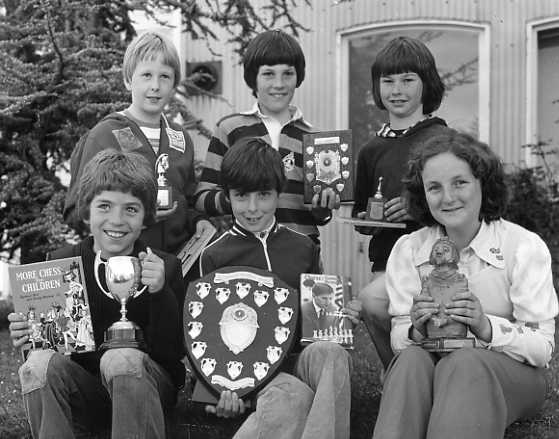
4th Exmouth & District Primary Schools’ Congress winners 1979
Front row (l-r) James Anderson (Best U-10 - Budleigh Salterton); Christopher Jones (1st overall - Withycombe); Rhona Dowling (Best Girl - Otterton).
Back row): Gavin White (Runner-Up – Withycombe); Simon Huxtable (League winning team – Withycombe Raleigh P. S.); Robert Davies 3rd overall (Brixington Juniors).
Overall winners in the early years were:-
| Year | Winner | School | ||
| 1st | 1976 | Robin Cotton | Otterton Primary School | |
| 2nd | 1977 | Christopher Morrish | Otterton Primary School | |
| 3rd | 1978 | Robert Davies | Brixington Junior School | |
| 4th | 1979 | Christopher Jones | Withycombe Raleigh P. S. | |
| 5th | 1980 | Gavin White | Withycombe Raleigh P. S. |
On the down-side, the following year Steve Boniface moved to Brighton after a decade’s involvement with the club. Also, the death of Stephen H. Crockett took another strong member. He had been a leading player between the wars, in 1937, for example, leading Middlesex to the county championship, playing Bd. 1 above the likes of the current British Champion William Winter, E. G. Sergeant and the future British Postal Champion, Harold Israel. After the war, the insurance company for which he worked sent him to South Africa, where he spent 11 years in Grahamstown. On retirement, he returned to the UK in 1977 and bought a house very near Rolle College. Quiet and unassuming, few in the club appreciated the chess career he’d had, and his presence in Exmouth was all too short.
On 15th February 1984 Ken Schofield died suddenly from a heart attack. At a Management Committee Meeting a few days later, Guy Sparke paid tribute to “his organising ability, sound judgment and chairmanship”, adding that “he’d been a major personality on the Devon chess scene”.
Notwithstanding the loss of Schofield, 1984 was a good year in terms of silverware, as Exmouth A won the Cottew Cup, and Exmouth B successfully defended the Turner Cup, while Guy Sparke became East Devon’s Individual Champion.
A new member at this time was Godfrey Quack (pronounced Kwork), a Cambridge-graduate who had had a career in the oil business, and in semi-retirement had taken on a sub-post office in Budleigh Salterton. He was a noted problemist specialising in Merediths (i.e. 2-movers involving about 12 pieces), whose compositions had been published nationally. In 1996 he collated 77 of his published problems and his friend Barry Barnes, an IM for Problem Composition, added an appreciation, and the whole was published in a small booklet by Keverel Chess. (ISBN 0-9531321-0-2). The effort involved was timely as Godfrey died early in 2000, leaving the booklet as his small bequest to the chess world.
The 1990s passed relatively quietly compared to the 1970s. There was just one team trophy in the decade, though club members dominated the East Devon Individual Championship until the controller Ray Shepherd gave up running it in 2002 and no-one could be found to take it over.
 Above: The two winning teams in the Exmouth & District League’s 18th season in May 1993.
Front row: Withycombe Raleigh’s Thomas Losey and John Stephens with the main trophy.
Back row: Tom Greenacre, Bronagh Griffiths, Kris Statham, Jennifer Richmond and Jessica Hope of the Dolphin School.
However, as the new millennium approached, Exmouth was about to become a major chess centre at a higher level. Both DCCA and the West of England Chess Union were finding the tournaments they ran were slowly declining in popularity. WECU’s annual Easter Congress and Championship, for example, had for over half a century moved around the South West, the idea being that each of the constituent counties could take a turn at hosting the prestigious event. In recent years it had tended to move between Weymouth, Weston-Super-Mare and Torbay, but it was becoming increasingly difficult to find suitable venues at a reasonable cost. The number of entries rarely exceeded 75 and regulars never knew from one year to the next where it might be held, or when, as Easter moved back and forth through the calendar, according to its own unfathomable formula. When the 1996 Congress at Torquay Boys’ Grammar School made a £400 loss and had to be bailed out by the Union with a £400 “loan”, the Executive knew things had to change.
At the 1998 AGM it was agreed that it should stop being peripatetic, and the Union General Secretary, Bob Jones, said he would explore the possibility of Exmouth having a suitable venue. His first port of call was to see a local property developer and former Exmouth Club member, John Fowler of Eagle Investments, who said he had just purchased a place that would be ideal – the Royal Beacon Hotel. One look around the playing hall was enough to know that a new home for chess had been found. It was fully carpeted making the room utterly quiet during play, with comfortable chairs, a bar and restaurant facilities. Not only was the owner a chess-player, but so was the hotel manager, Bill Ellis, an American who had played Walter Browne in a simultaneous match in the US. The only constraint was the limit of 100 players, though as the event had never approached this number before it was not seen as a problem.
So the Easter 1999 Congress seemed destined to be held there, and so it was, with WECU President Ian George reporting back to the 2000 WECU Executive that it was the best congress he had ever played in. Entries were up and it was a financial success too, and there was a unanimous vote to keep it in Exmouth for the foreseeable future.
WECU Champions at Exmouth.
| Year | Champion | County |
| 1999 | Neil Crickmore | Devon |
| 2000 | Jack Rudd | Somerset |
| 2001 | James T. Sherwin | Somerset |
| 2002 | Gerald Moore | Somerset |
| 2003 | Matthew Turner | Somerset |
| 2004 | Matthew Turner | Somerset |
| 2005 | Jack Rudd | Somerset |
| 2006 | Matthew Turner | Somerset |
| 2007 | Matthew Turner | Somerset |
| 2008 | Ian Thompson | Somerset |
| 2009 | Geoff Taylor | Glos. |
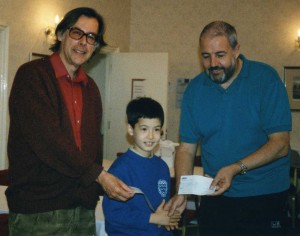
Above: The noted problemist, David Shire and a very young David Howell receive their Grading prize cheques from Congress Secretary Adrian Rookes at the 2001 WECU Congress in Exmouth.
Howell went on to become British Champion in 2009.
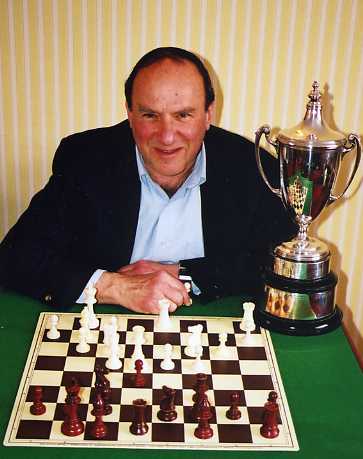
Above: James T. Sherwin, with the WECU Championship trophy in 2001.
Sherwin was born in New York and was part of the US scene there in the late 50’s and 60’s, which involved Bobby Fischer, Fine, Reshevsky, Saidy, Bisguier & Lombardy among many others. He knew and played them all.
Also in 1999 Steve Boniface took early retirement, which left him free to pursue this chess interests full time. Seeing the success of the WECU Congress he met with Bob Jones and Bill Ellis to explore two other ideas in which the Royal Beacon Hotel could be used.
One idea was a tournament only for strong players who were seeking title norms. Although the Hotel manager was keen on the plan, it never came to fruition. The other idea was for a Seniors Congress, where scores would go toward the Seniors’ section of the BCF’s Grand Prix scheme, as it was then formulated. This did go ahead and the first Seniors event was held in November 2000 with an entry of just 27 players, well short of the stated seating limit of 80. As Steve Boniface was giving his services free and prizes were very modest, it just about broke even. Notwithstanding this disappointing response, it was persevered with, and the entry gradually picked up as each year went by. One refinement introduced with the idea of boosting the overall entry, was to include a so-called Junior section for the 50-somethings – those who are too young for the main show, but wanted to be part of it. It’s a regular cause of amusement when these grown men refer to themselves as Juniors. The 10th Seniors Congress was held in November 2009 with over 80 players participating.
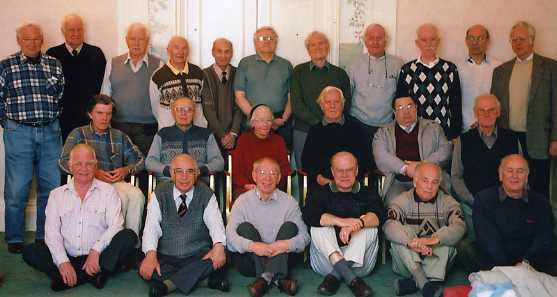
2nd Seniors Congress – 2001, many of whom went on to play in most years that decade:
Front row (l–r): Bill Davies; Yusef Ehtesham; Peter Carrick; Brian Ross; Alan Sherriff, Ivor Annetts.
Middle row: Mike Kaye; Alf Bullock; Elaine Pritchard (née Saunders); David Pritchard; Dave Burt; Clive Deakin.
Back row. Don Turtle; Mike Stoop; Robert Ryan; Ken Bloodworth; John Gorodi; Jim Nicolson; Frank Chambers; Bill Frost; Bill Newrick; ? ; Trevor Holt.
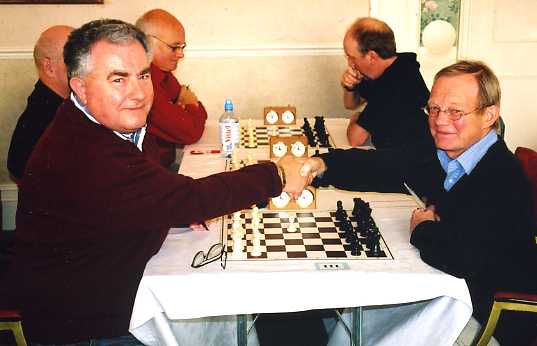
Neat & Tidy!
At the 6th Seniors Congress, former Club member Roger Neat was drawn against Norman Tidy in the last round, giving the pairing Neat v Tidy, something both had earnestly wanted for several years, but this was the first opportunity to do it legitimately. It was not a fix.
2001 saw the DCCA celebrating the centenary of its foundation. Several ideas were mooted but only one came to fruition, that of World Championship contender, Michael Adams, putting on a simultaneous display at the Royal Beacon on Sunday 16th September. Taking up the challenge were 37 local players, who included several of Devon’s top players. Adams finished them all off in double quick time. Afterwards, Ken Bloodworth, who had played in a number of these matches against World Champions, said Michael’s performance was “just awesome” and more impressive than any he had been involved in.
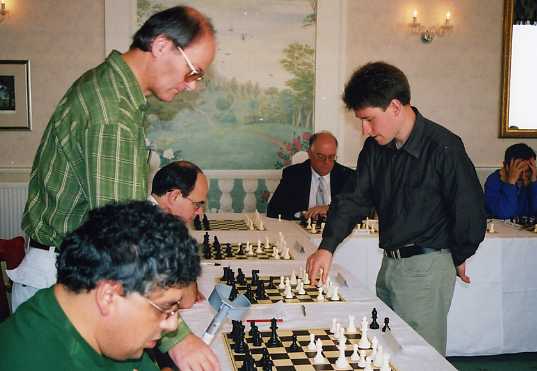
Above: Michael Adams makes his rounds during the simultaneous match at the Royal Beacon Hotel.
In the foreground is Andrew Wright (Plymouth); Tony Tatam (Plymouth and physically unable to sit at the time); Hotel Manager Bill Ellis is watching Adams move at his board.
In the background is club member and DCCA President, Phil Trussler, and Malcolm Belt (head in hands).
At this time, Exmouth Club members had a high profile within the county, filling. no less than 8 key DCCA posts; those of President, Deputy President, General Secretary, Competitions Secretary, Grading Officer, Publicity Officer and two delegates to WECU. This was probably without precedent in the Association’s 100 year history, and while a commendable effort on the part of a small club, was generally accepted as not a good thing, as it illustrated how volunteers were not coming forward from other areas.
In 2000 DCCA noted that not only were club entries in their tournaments in decline, but many strong players were not participating in those teams that were active. To help remedy this situation, the AGM agreed that clubs could become more proactive in recruiting new members to play in Devon leagues. Exmouth rallied to the call and enlisted players like Mike Cox, a strong but inactive player who lived in a small village outside Exmouth and was unable to drive. Ken Derrick, a former President of Gloucestershire and the Bristol League, was similarly discovered living a quiet life in a small village near Exmouth and inactive in the wider Devon scene. Both were glad for the opportunity to play serious county-wide chess. Trefor Thynne re-joined his old club for a season and the experience revived his appetite for club chess and on the strength of that, he went on to reform the Newton Abbot club in his home town, which has subsequently blossomed.
These were the key to Exmouth winning the Bremridge Cup for the first time in its 100 year history, and its subsequent victories (see table below).
In 2001, on the basis of its sudden rush of activity in several areas of chess, it was suggested that the Club submit an application for the title of BCF Club of the Year. This was duly done and the BCF decided to create a new category and install Exmouth as its first winner – that of Small Club of the Year (2001).
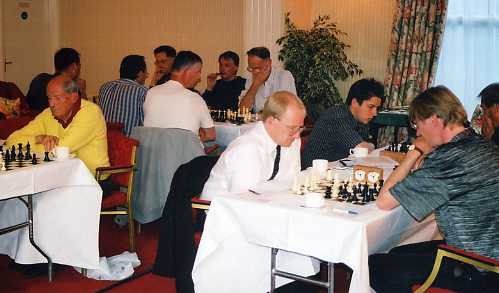
In June 2002 a team of chessplayers from Torquay’s twinned town of Hellevoetsluis, toured the area, playing several local clubs, with Trefor Thynne acting as liaison. Their match against Exmouth took place at the Royal Beacon Hotel and the occasion was also used for the presentation of a cheque from the Town Council to support the good work of the Junior Club, which at this time was being run by Tim Onions.
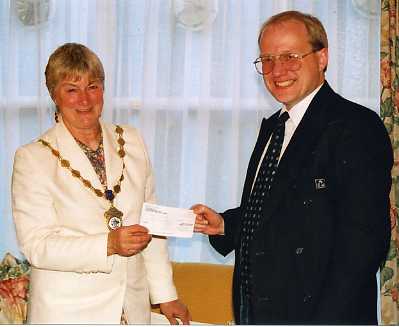
Above: The Mayor of Exmouth, Cllr. Pat Graham, presents a cheque to Club President, Mark Abbott.
Below: Exmouth v Hellevoetsluis - June 2002:
Exmouth players are all facing the camera l-r: Guy Sparke (in yellow); Malcolm Belt; Dave Rogers (chewing pen); Dave Adams; Mark Abbott; John Stephens.
In 2005, the Club received a shock when Plymouth University, who had been given the Rolle College campus by Devon County Council, announced it was to close the site and sell it off to the highest bidder. The Club was given three years notice, and there were hopes that the buildings could be retained by the town for educational use, but the time came in 2008 when the College, home to the club for 37 years, locked its doors for the last time, and a temporary room for the club was found in a working men’s club in the town centre. This in turn was sold to a developer and the club had to move on again, and currently resides at the Age Concern premises in New Street.
The trials and tribulations of the Club in recent years have not detracted from its efforts to put out competitive teams whenever possible. Here is their team looking undeterred at the prospect of being about to face a strong Newton Abbot team in the showdown final match of the 2006-07 season in the Bremridge Cup.

Above: Exmouth’s Bremridge team looking unfazed by the prospect of being about to face Newton Abbot in a deciding 2007 match.
Seated (l-r): Kevin Hurst; Mark Abbott; Brian Hewson.
Standing: David Toms; Ian Jamieson; John Stephens.
Above: The team with the Thomas Cup for winning the Devon Team RapidPlay Championship in 2008 and 2009.
Front: John Stephens & Ian Jamieson. Back: Brians Hewson and Gosling.
Summary of Exmouth Successes.
D. C. C. A.
| Div. 1Bremridge Cup | Div. 2Mamhead | Div. 3Moyle | ||
| Started 1901 | Started 1935 | Started 1910 | ||
| Exmouth won in | Exmouth won in | Exmouth won in | ||
| 2002 | 1935 | 1923 | ||
| 2003 | 1936 | 1960 | ||
| 2004 | 1938 | |||
| 2005 | 1950 | |||
| 2007 | 1951 | |||
| 2009 | 1952 | |||
| 1954 | ||||
| 1972 | ||||
| 1978 | ||||
| 1989 | ||||
| 2004 | ||||
| 2007 | ||||
| 2008 | ||||
| 2009 |
Exeter & District League.
| Div. 1Cottew Cup | Div 2Turner Cup | IndividualChampionship | ||||
| Started 1954 | Started 1963 | Started 1957 | ||||
| Exmouth A won in | Exmouth B won in | Exmouth winners | ||||
| 1954 | 1967 | Ian Ashford | 1973 | |||
| 1960 | 1974 | Stuart Landon | 1974 | |||
| 1976 | 1976 | Dennis Tongue | 1975 | |||
| 1977 | 1978 | Stuart Landon | 1976 | |||
| 1984 | 1979 | Guy Sparke | 1984 | |||
| 2000 | 1983 | Fred Hodge | 1992 | |||
| 2002 | 1984 | Bob Jones | 1993 | |||
| 2009 | 1985 | Bob Jones | 1994 | |||
| 1989 | Guy Sparke | 1995 | ||||
| 1992 | Bob Jones (joint) | 1997 | ||||
| 2001 | Bob Jones (joint) | 1998 | ||||
| 2004 | No contest after | 2002 |
Internal Tournaments.
| Tempest Trophy | Walton’s Cup | |||
| Championship | Knockout | |||
| 1970 | ——- | |||
| 1971 | Ken Schofield | ——- | ||
| 1972 | Ken Schofield | ——- | ||
| 1973 | Ken Schofield | ——— | ||
| 1974 | Ken Schofield | ——- | ||
| 1975 | Guy Sparke | Ivan Legg | Rolle student from Glos. | |
| 1976 | Steve Boniface | Stuart Landon | Exmouth-born &Town resident | |
| 1977 | Ken Schofield | Stephen Crockett | Ex Middx champion; town resident; retired. | |
| 1978 | Ken Schofield | Stuart Landon | ||
| 1979 | Guy Sparke | Trefor Thynne | Local resident. | |
| 1980 | Steve Boniface | Robin Cotton | Former Devon junior champion; local | |
| 1981 | S. Landon & R. Cotton | Guy Sparke | Budleigh resident | |
| 1982 | Robin Cotton | Guy Sparke | ||
| 1983 | Guy Sparke | Tim Buckley | Topsham resident; club member; junior. | |
| 1984 | No award | Guy Sparke | ||
| 1985 | Guy Sparke | Malcolm Horne | Town resident | |
| 1986 | Malcolm Horne | Rev. Denis Tongue | Town resident; retired | |
| 1987 | Guy Sparke | Nicholas Worthing | Budleigh resident; retired inventor | |
| 1988 | Bob Jones | Arthur Coates | Town resident; retired forester. | |
| 1989 | Bob Jones | Nicholas Worthing | ||
| 1990 | Guy Sparke | Bob Jones | Town resident. | |
| 1991 | Guy Sparke | Guy Sparke | ||
| 1992 | Guy Sparke | Dave Rogers | Former Rolle student; Town resident | |
| 1993 | Fred Hodge | Fred Hodge | Exmouth-born and resident | |
| 1994 | ? | Malcolm Belt | Town resident | |
| 1995 | ? | Bob Jones | ||
| 1996 | ? | Malcolm Belt | ||
| 1997 | ? | Philip Trussler | Topsham resident; Club President. | |
| 1998 | Philip Trussler | Philip Trussler | ||
| 1999 | Philip Trussler | Philip Trussler | ||
| 2000 | Philip Trussler | Philip Trussler | ||
| 2001 | Philip Trussler | |||
| 2002 | Mark Abbott | |||
| 2003 | Bob Jones | |||
| 2004 | Adam Woodruff | |||
| 2005 | Bob Jones | |||
| 2006 | Mark Abbott | |||
| 2007 | John Stephens | |||
| 2008 | John Stephens | John Stephens | ||
| 2009 | John Stephens | |||
| 2010 |
 Posted in Club History |
  Tags: chess history, David Howell, Exmouth Club, Jim Sherwin, Koltanowski, Mickey Adams |
  Comments Closed
View Literature & Anthologies
Book list of Literature & Anthologies
NB: This booklist is still a work in progress at the moment and will be added to regularly until complete. Recently sold titles may be shown in “strikethrough”. Please check the page for terms & conditions and definition of terms used.
Book List
To order books:-
1. For convenience, enquire via e-mail about availability of titles.([email protected])
2. Do not send remittance with first postal enquiry.
3. Post and packaging will be charged at the cheapest rate available.
4. Regular customers will receive an invoice with books; new customers, or those with large orders, may be asked to settle before despatch.
5. Make all cheques payable to “Keverel Chess Books”. Overseas customers may either pay by sterling cheque drawn on a UK bank, or, if more convenient, by personal cheque in any currency, for which there will be a small surcharge, equivalent to £3 sterling per cheque. Money orders must be specifically of an international nature. Please note that banks no longer accept Eurocheques. Also, we do not deal with Western Union money orders.
A list of all books in stock will be maintained on this website. This will be the best way to monitor latest additions. Otherwise, orders are taken on a “first come – first served “ basis.
Book descriptions are based on the following abbreviations, which are intended as a guide to a book’s condition. Every effort has been made to come to a reasonable assessment. A book’s condition will be reflected in its price.
F+ = new book; no previous owner.
F = fine (nearly new; almost in mint condition).
VG = very good (some signs of use, but no noticeable imperfections).
G = good; (some acceptable wear but no major damage).
P = poor; (text complete but otherwise seriously defective in some way).
To help further, in borderline cases, a + or – sign may indicate whether a book falls in the upper or lower end of the band indicated:- e.g. G+ = one of the better books in the range deemed Good.
Insc.= Inscription or ownership stamp.
DW = Dust wrapper intact.
PB = paperback or softback (otherwise hardback assumed).
AN = Algebraic notation (otherwise descriptive assumed).
XLib = Former public library book.
ND = no published date.
LN = Catalogue no. in Bibliotheca van der Linde-Niemeijeriana 1955.
View Openings
Book list of Openings
NB: This booklist is still a work in progress at the moment and will be added to regularly until complete. Recently sold titles may be shown in “strikethrough”. Please check the page for terms & conditions and definition of terms used.
Book List Goes Here…..
To order books:-
1. For convenience, enquire via e-mail about availability of titles.([email protected])
2. Do not send remittance with first postal enquiry.
3. Post and packaging will be charged at the cheapest rate available.
4. Regular customers will receive an invoice with books; new customers, or those with large orders, may be asked to settle before despatch.
5. Make all cheques payable to “Keverel Chess Books”. Overseas customers may either pay by sterling cheque drawn on a UK bank, or, if more convenient, by personal cheque in any currency, for which there will be a small surcharge, equivalent to £3 sterling per cheque. Money orders must be specifically of an international nature. Please note that banks no longer accept Eurocheques. Also, we do not deal with Western Union money orders.
A list of all books in stock will be maintained on this website. This will be the best way to monitor latest additions. Otherwise, orders are taken on a “first come – first served “ basis.
Book descriptions are based on the following abbreviations, which are intended as a guide to a book’s condition. Every effort has been made to come to a reasonable assessment. A book’s condition will be reflected in its price.
F+ = new book; no previous owner.
F = fine (nearly new; almost in mint condition).
VG = very good (some signs of use, but no noticeable imperfections).
G = good; (some acceptable wear but no major damage).
P = poor; (text complete but otherwise seriously defective in some way).
To help further, in borderline cases, a + or – sign may indicate whether a book falls in the upper or lower end of the band indicated:- e.g. G+ = one of the better books in the range deemed Good.
Insc.= Inscription or ownership stamp.
DW = Dust wrapper intact.
PB = paperback or softback (otherwise hardback assumed).
AN = Algebraic notation (otherwise descriptive assumed).
XLib = Former public library book.
ND = no published date.
LN = Catalogue no. in Bibliotheca van der Linde-Niemeijeriana 1955.
View Problems & Studies
Book list of Problems & Studies
NB: This booklist is still a work in progress at the moment and will be added to regularly until complete. Recently sold titles may be shown in “strikethrough”. Please check the page for terms & conditions and definition of terms used.
Book List
To order books:-
1. For convenience, enquire via e-mail about availability of titles. ([email protected])
2. Do not send remittance with first postal enquiry.
3. Post and packaging will be charged at the cheapest rate available.
4. Regular customers will receive an invoice with books; new customers, or those with large orders, may be asked to settle before despatch.
5. Make all cheques payable to “Keverel Chess Books”. Overseas customers may either pay by sterling cheque drawn on a UK bank, or, if more convenient, by personal cheque in any currency, for which there will be a small surcharge, equivalent to £3 sterling per cheque. Money orders must be specifically of an international nature. Please note that banks no longer accept Eurocheques. Also, we do not deal with Western Union money orders.
A list of all books in stock will be maintained on this website. This will be the best way to monitor latest additions. Otherwise, orders are taken on a “first come – first served “ basis.
Book descriptions are based on the following abbreviations, which are intended as a guide to a book’s condition. Every effort has been made to come to a reasonable assessment. A book’s condition will be reflected in its price.
F+ = new book; no previous owner.
F = fine (nearly new; almost in mint condition).
VG = very good (some signs of use, but no noticeable imperfections).
G = good; (some acceptable wear but no major damage).
P = poor; (text complete but otherwise seriously defective in some way).
To help further, in borderline cases, a + or – sign may indicate whether a book falls in the upper or lower end of the band indicated:- e.g. G+ = one of the better books in the range deemed Good.
Insc.= Inscription or ownership stamp.
DW = Dust wrapper intact.
PB = paperback or softback (otherwise hardback assumed).
AN = Algebraic notation (otherwise descriptive assumed).
XLib = Former public library book.
ND = no published date.
LN = Catalogue no. in Bibliotheca van der Linde-Niemeijeriana 1955.
View Instructional Works inc. Middle- & End Games
Book list of Instructional Works inc. Middle- & Endgames
NB: This booklist is still a work in progress at the moment and will be added to regularly until complete. Recently sold titles may be shown in “strikethrough”. Please check the page for terms & conditions and definition of terms used.
Book List
To order books:-
1. For convenience, enquire via e-mail about availability of titles. ([email protected])
2. Do not send remittance with first postal enquiry.
3. Post and packaging will be charged at the cheapest rate available.
4. Regular customers will receive an invoice with books; new customers, or those with large orders, may be asked to settle before despatch.
5. Make all cheques payable to “Keverel Chess Books”. Overseas customers may either pay by sterling cheque drawn on a UK bank, or, if more convenient, by personal cheque in any currency, for which there will be a small surcharge, equivalent to £3 sterling per cheque. Money orders must be specifically of an international nature. Please note that banks no longer accept Eurocheques. Also, we do not deal with Western Union money orders.
A list of all books in stock will be maintained on this website. This will be the best way to monitor latest additions. Otherwise, orders are taken on a “first come – first served “ basis.
Book descriptions are based on the following abbreviations, which are intended as a guide to a book’s condition. Every effort has been made to come to a reasonable assessment. A book’s condition will be reflected in its price.
F+ = new book; no previous owner.
F = fine (nearly new; almost in mint condition).
VG = very good (some signs of use, but no noticeable imperfections).
G = good; (some acceptable wear but no major damage).
P = poor; (text complete but otherwise seriously defective in some way).
To help further, in borderline cases, a + or – sign may indicate whether a book falls in the upper or lower end of the band indicated:- e.g. G+ = one of the better books in the range deemed Good.
Insc.= Inscription or ownership stamp.
DW = Dust wrapper intact.
PB = paperback or softback (otherwise hardback assumed).
AN = Algebraic notation (otherwise descriptive assumed).
XLib = Former public library book.
ND = no published date.
LN = Catalogue no. in Bibliotheca van der Linde-Niemeijeriana 1955.
View Tournaments & Matches
Book list of Tournaments & Matches
NB: This booklist is still a work in progress at the moment and will be added to regularly until complete. Recently sold titles may be shown in “strikethrough”. Please check the page for terms & conditions and definition of terms used.
Book List
To order books:-
1. For convenience, enquire via e-mail about availability of titles. ([email protected])
2. Do not send remittance with first postal enquiry.
3. Post and packaging will be charged at the cheapest rate available.
4. Regular customers will receive an invoice with books; new customers, or those with large orders, may be asked to settle before despatch.
5. Make all cheques payable to “Keverel Chess Books”. Overseas customers may either pay by sterling cheque drawn on a UK bank, or, if more convenient, by personal cheque in any currency, for which there will be a small surcharge, equivalent to £3 sterling per cheque. Money orders must be specifically of an international nature. Please note that banks no longer accept Eurocheques. Also, we do not deal with Western Union money orders.
A list of all books in stock will be maintained on this website. This will be the best way to monitor latest additions. Otherwise, orders are taken on a “first come – first served “ basis.
Book descriptions are based on the following abbreviations, which are intended as a guide to a book’s condition. Every effort has been made to come to a reasonable assessment. A book’s condition will be reflected in its price.
F+ = new book; no previous owner.
F = fine (nearly new; almost in mint condition).
VG = very good (some signs of use, but no noticeable imperfections).
G = good; (some acceptable wear but no major damage).
P = poor; (text complete but otherwise seriously defective in some way).
To help further, in borderline cases, a + or – sign may indicate whether a book falls in the upper or lower end of the band indicated:- e.g. G+ = one of the better books in the range deemed Good.
Insc.= Inscription or ownership stamp.
DW = Dust wrapper intact.
PB = paperback or softback (otherwise hardback assumed).
AN = Algebraic notation (otherwise descriptive assumed).
XLib = Former public library book.
ND = no published date.
LN = Catalogue no. in Bibliotheca van der Linde-Niemeijeriana 1955.
View Game Collections (General)
Book list of Game Collections (General)
NB: This booklist is still a work in progress at the moment and will be added to regularly until complete. Recently sold titles may be shown in “strikethrough”. Please check the page for terms & conditions and definition of terms used.
Book List
To order books:-
1. For convenience, enquire via e-mail about availability of titles. ([email protected])
2. Do not send remittance with first postal enquiry.
3. Post and packaging will be charged at the cheapest rate available.
4. Regular customers will receive an invoice with books; new customers, or those with large orders, may be asked to settle before despatch.
5. Make all cheques payable to “Keverel Chess Books”. Overseas customers may either pay by sterling cheque drawn on a UK bank, or, if more convenient, by personal cheque in any currency, for which there will be a small surcharge, equivalent to £3 sterling per cheque. Money orders must be specifically of an international nature. Please note that banks no longer accept Eurocheques. Also, we do not deal with Western Union money orders.
A list of all books in stock will be maintained on this website. This will be the best way to monitor latest additions. Otherwise, orders are taken on a “first come – first served “ basis.
Book descriptions are based on the following abbreviations, which are intended as a guide to a book’s condition. Every effort has been made to come to a reasonable assessment. A book’s condition will be reflected in its price.
F+ = new book; no previous owner.
F = fine (nearly new; almost in mint condition).
VG = very good (some signs of use, but no noticeable imperfections).
G = good; (some acceptable wear but no major damage).
P = poor; (text complete but otherwise seriously defective in some way).
To help further, in borderline cases, a + or – sign may indicate whether a book falls in the upper or lower end of the band indicated:- e.g. G+ = one of the better books in the range deemed Good.
Insc.= Inscription or ownership stamp.
DW = Dust wrapper intact.
PB = paperback or softback (otherwise hardback assumed).
AN = Algebraic notation (otherwise descriptive assumed).
XLib = Former public library book.
ND = no published date.
LN = Catalogue no. in Bibliotheca van der Linde-Niemeijeriana 1955.